Why Creaking Bikes Are Hard to Diagnose
Bike creaking has gotten complicated with all the bad advice flying around. “Just grease your pedals.” “Tighten your cleats.” “It’s definitely the bottom bracket.” People throw fixes at the problem randomly and wonder why nothing works. I spent three seasons chasing a creak across three different bikes — a 2019 Trek Émonda, a cheap commuter, and my current endurance rig — before I finally understood why.
Sound travels through aluminum and carbon like a rumor. A bottom bracket creak originates deep in the shell, bounces up the seat tube, and arrives at your ears sounding like it’s coming from your left foot. Your cleat interface squeaks, the noise ricochets off the crank arm, and suddenly you’re convinced it’s the pedal threads. This is the whole problem. Generic advice skips this entirely. What you actually need is a systematic elimination process — and that’s what this article gives you.
Start Here — The Most Common Culprits
Before you touch a single bolt, understand which creaks happen when. Pattern first. Source second.
- Pedal threads — A creak that gets worse under hard pedaling pressure, especially out of the saddle. Happens on both sides equally.
- Bottom bracket — A creak that only appears under load or during hard efforts. Disappears when you coast. Feels deep and systemic.
- Cleat-to-pedal interface — Creaks only when you’re actually pedaling, especially when seated. Goes silent the moment you unclip or stop applying force.
- Crank bolts — A creak that correlates with crank rotation. Usually one side only. Often worse at specific crank positions.
- Seatpost — A creak that only happens when you’re seated and pedaling hard. Disappears when you stand up.
Keep these in your head as you move through the next section. Most riders skip this mental inventory and go straight to random greasing. That’s how you waste a perfectly good Saturday and still hear creaking on Sunday morning. Don’t make my mistake.
How to Isolate Where the Creak Is Coming From
Get your bike on a trainer — at least if you want accurate results. You’ll run four tests. Each one kills off possibilities until you’ve cornered the actual problem. So, without further ado, let’s dive in.
Test One — Seated versus Out of the Saddle
Pedal hard while seated for thirty seconds. Creak present? Now stand up and hammer it. Does it disappear completely or just change character?
Gone when you stand? Your seatpost is probably the culprit. Weight shifting alters how the post loads inside the frame. Creak stays identical? Move to Test Two.
Test Two — One-Legged Pedaling
This is the move that actually works. Unclip one foot. Pedal ten full rotations on the other leg only. Listen hard. Switch legs. Repeat.
Creak only on the left leg? You’ve narrowed it to that pedal, that cleat, or that crank arm. Both legs producing it equally? That points toward the bottom bracket or frame flex. Write this down — seriously, on actual paper. Your memory will absolutely fail you when you’re elbow-deep in a teardown twenty minutes later.
Test Three — Grease and Retest
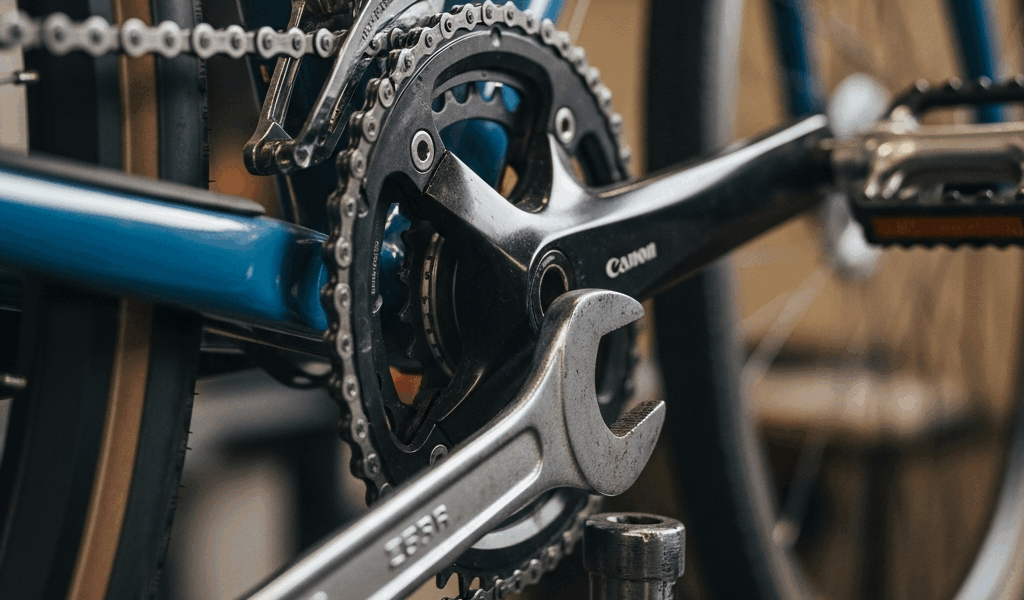
Remove both pedals using a 15mm wrench. The non-drive side pedal has left-hand threads — turn clockwise to remove it. I’m apparently someone who learns this only through embarrassment, and spending twenty minutes cranking the wrong direction while my wife watched from the doorway works for me as a permanent memory aid. Regular instruction never did.
Examine the threads on both spindles. Dry? Apply a thin coat of marine grease — Finish Line Teflon grease works, Park Tool HPG-1 works, basic marine grease from the hardware store for about $6 works. Reinstall both pedals to 35-40 Nm. That’s 26-30 foot-pounds if your torque wrench speaks imperial. Short test ride. Better?
Yes? You’re done. No? Continue to Test Four.
Test Four — Cleat Inspection
Unclip your shoes. Look at where the cleat contacts the pedal platform. Grit, dried mud, calcium deposits from sweat — any of it creates micro-movement that translates into creaking. Clean everything with an old toothbrush. Then apply a small amount of grease to the cleat’s contact points and the pedal platform surface.
Reinstall your cleats. Bolts snug at 4-5 Nm — that’s firm hand-tight, not white-knuckle tight. Test ride. A surprising number of creaks die right here because riders never think to look at this interface at all.
How to Fix Each Type of Creak
Pedal Thread Creaking
You’ve already run through this during Test Three. But what is pedal thread creaking exactly? In essence, it’s the spindle micro-rotating against dry threads under load. But it’s much more than that — it’s also the single most misdiagnosed creak on the bike, because the noise location feels obvious and the actual fix feels too simple.
Clean the spindle threads with a rag. Grease them — marine grease, tri-flow, Boeshield T-9, whatever you have. Reinstall to 35-40 Nm. Most pedal boxes include a torque spec. Use it.
Guilty of over-tightening a pedal before? The threads might be stripped. In that case, new pedals are in your future. Check warranty first — Shimano, Look, and Wahoo all cover manufacturing defects, and sometimes damaged threads qualify.
Cleat Interface Creaking
Probably should have opened with this section, honestly. It solves roughly forty percent of the bike creaks that riders confidently blame on pedal threads. The creak originates from micro-movement between the cleat body and the pedal platform — tiny, repetitive, maddening.
- Remove your shoe from the pedal.
- Clean the pedal platform with a stiff brush. Every grain of dirt. Gone.
- Clean the contact surface of your cleat with soap and water.
- Let both dry completely.
- Apply a thin layer of grease to the pedal platform where the cleat makes contact.
- Reinstall your cleat, torquing bolts to spec — usually 4-5 Nm for road pedals, 6 Nm for most mountain cleats.
- Test ride.
That’s what makes this fix endearing to us cyclists — it’s almost insultingly simple. Clean thing. Grease thing. Tighten thing correctly. Silence.
Crank Bolt Creaking
Crank arms bolt to the spindle. Loose bolts creak at specific crank positions — typically when the arm passes through 3 o’clock or 9 o’clock. You’ll feel it rhythmically, one side only, same spot every rotation.
You’ll need an Allen key — usually 6mm or 8mm depending on your crank. Torque specs differ by brand. Shimano calls for 12-14 Nm. SRAM specifies 10-12 Nm. FSA lands at 12 Nm. Check your crank’s manual before you guess. Tighten both sides. Ride again.
Bottom Bracket Creaking
This is where the fun stops. A BB tool and crank puller together run around $60-120 — at least if you’re buying quality tools — and the process requires patience that not everyone has on a Sunday afternoon.
A dedicated BB tool might be the best option here, as this repair requires precise interface contact with the shell. That is because improper tools round off the notches and turn a $50 part replacement into a $200 shop rescue job.
Cartridge-style BBs are sealed and non-serviceable at home. Cup-and-cone BBs are rebuildable if you have the tools and the inclination. Modern bikes almost universally use cartridge-style. Replacement parts run $40-80. Add labor at a shop.
Take it in unless you have experience and the specific tools. Seriously.
When the Creak Still Will Not Go Away
You’ve run every test. Fixed everything fixable. The creak is still there. Here’s what’s left.
Frame Flex
Some creaks come directly from the frame — the down tube, seat tube, or chain stays flexing under hard load. No repair exists here short of frame replacement. Before accepting that verdict, though: grip the seat tube firmly in your hand while pedaling hard. Creak stops? Frame flex is your problem. Accept it or upgrade. Those are genuinely the only two options.
Headset
A loose headset creaks under load. Grab the handlebars and rock the bike front to back. Feel any play? Tighten the headset cap bolt — usually a 4mm or 5mm Allen. Snug, not crushing. A quarter-turn often solves it entirely. That was probably ten seconds of work.
Wheel Skewers
Loose skewers create vibration that mimics creaking convincingly. Tighten them until they feel solid — no rattle, no movement. Check both wheels.
While you won’t need a full tool kit for this entire process, you will need a handful of specific items: a 15mm pedal wrench, a torque wrench, appropriate Allen keys, and some marine-grade grease. First, you should confirm which creak pattern matches your bike — at least if you want to avoid disassembling the wrong component entirely.
If you’ve done all of this and the creak is still there, take the bike to a shop. You’re past the point where any guide helps. Mechanics spend years training their ears to isolate these sounds. The diagnostic fee is worth it.
But honestly? I’m betting you’ve already found it. Most creaks collapse during the cleat and pedal thread checks. This new understanding of creak diagnosis took off among riders several years ago and eventually evolved into the systematic approach enthusiasts know and swear by today. Start there, trust the elimination process, and ride in silence.

Stay in the loop
Get the latest cycling gear galaxy updates delivered to your inbox.