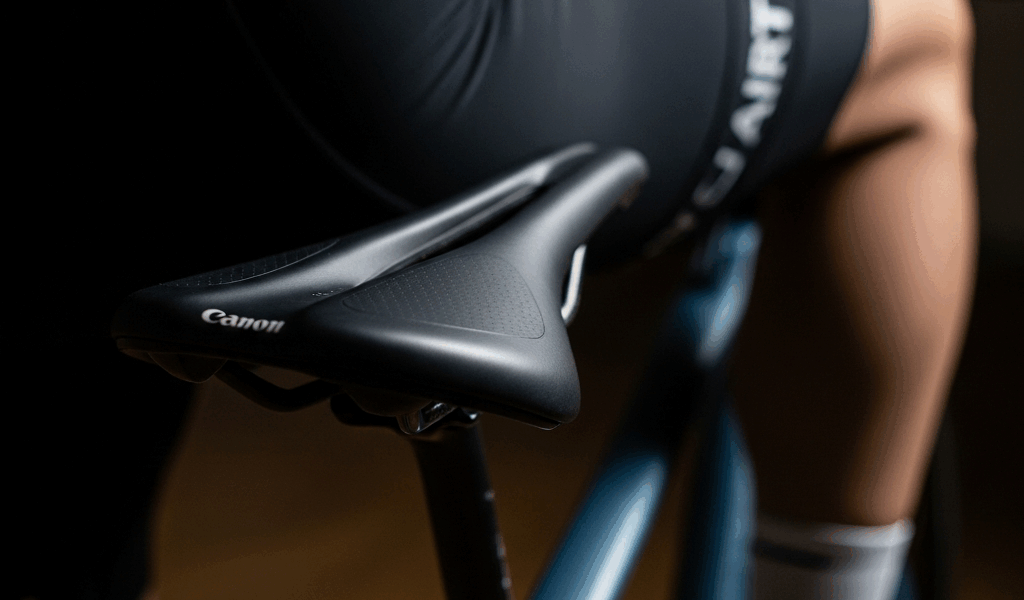
Where It Hurts Tells You Everything
Bike saddle pain has gotten complicated with all the “just buy a better saddle” noise flying around. Before you spend $300 on something new, stop. Where it hurts is diagnostic data — and it almost always points to something you can fix for free.
As someone who once finished a 40-mile ride barely able to sit down afterward, I learned everything there is to know about saddle pain the hard way. Two weeks of research later, I discovered my saddle height was off by half an inch. One adjustment. 90% of the problem gone. Today, I will share it all with you.
Pain on your sit bones — the bony points digging into the saddle — usually means a pressure or width issue. Perineal or soft tissue pain points to tilt or fore-aft position. Inner thigh chafing is almost always shorts or saddle width. Three completely different problems. Three completely different fixes. Generic upgrade advice skips the diagnosis entirely and costs you money you didn’t need to spend.
Sit Bone Pain — Your Saddle Height or Tilt Is Off
But what is sit bone pain, exactly? In essence, it’s concentrated pressure on the ischial tuberosities — the two bony points your pelvis rests on. But it’s much more than that. It’s usually a signal your bike geometry is working against your body.
Saddle height is almost always the first culprit. The heel-on-pedal method is reliable because it’s rooted in actual biomechanics. Put on your cycling shoes, sit on the saddle in your normal position, drop one pedal to its lowest point, and rest your heel on it. Your leg should be fully extended — straight, not locked. Knee still bent? Saddle is too low. Hips rocking to reach the pedal? Too high.
I adjusted mine 8 millimeters upward. Felt the difference before I even finished the block.
Height is only half the equation, though. Saddle tilt wrecks people and nobody talks about it. Even 2 degrees nose-up shifts pressure directly into your sit bones. Grab a phone level app — just set it flat on top of the saddle, parallel to the bike. Aim for dead neutral or a hair nose-down. Never nose-up. No phone app? A small bubble level from any hardware store runs about $4.
Probably should have opened with this section, honestly. Tilt is completely invisible to the naked eye. Your saddle can look perfectly level and still be sitting at 3 degrees — enough to cause real problems over a long ride.
Soft Tissue or Perineal Pain — Fix the Angle and Position
Nobody wants to talk about this one. I’ll be direct anyway.
A nose-down tilt throws your weight forward onto soft tissue. A nose-up tilt creates pressure from below. Both are wrong. Both hurt. Start with tilt — fix that first before touching anything else.
Then look at fore-aft position. Move the saddle along its rails in 5-millimeter increments, take a short ride, and assess. Most people find the sweet spot within 10 millimeters of where they started. Too far forward compresses tissue against the nose. Too far back does much the same thing, just differently.
That’s where saddle shape starts entering the conversation. A flat saddle distributes pressure differently than a curved one. Center cutouts — like those on the Specialized Power or Selle Italia SLR — reduce soft tissue contact by design. But before you spend anything, exhaust the free fixes. Nine times out of ten, correct height and tilt solve this without a single dollar changing hands.
Padding density matters here too. I’m apparently a firm-saddle person, and my Selle Italia Turbo works for me while plusher saddles like the Selle Royal Respiro never did. Don’t make my mistake of assuming more padding equals more comfort. A saddle that’s too soft lets your body sink unevenly, creating pressure in exactly the wrong spots on longer rides.
Chafing and Inner Thigh Rubbing — Shorts and Saddle Width
Inner thigh chafing is rarely a saddle problem. Almost every time, it’s your shorts — or a saddle that’s simply too wide for your body.
First, you should ditch the underwear — at least if you’re riding more than about 20 minutes. Cycling bibs are designed so the chamois sits directly against your skin. An extra layer underneath creates friction and bunching. That was probably the cause of half the chafing complaints I’ve ever heard. Also wash your bibs in warm water with mild soap and air dry them. Dryer heat and chlorine degrade the chamois coating faster than miles do.
Second, saddle width should roughly match your sit bone width plus 10 to 20 millimeters of margin. A saddle too wide for your pelvis forces your thighs to brush the edges with every pedal stroke. Measure your sit bones by sitting on a piece of corrugated cardboard for about a minute, then measuring the distance between the two indentations. Add 20 millimeters — that’s your target width.
Most saddles run between 130 and 160 millimeters. The Specialized Power comes in 112, 143, and 168 millimeter versions. Selle Italia offers similar variety across their lineup. A 155-millimeter saddle might be perfect for someone with 125-millimeter sit bones and completely miserable for someone with 145-millimeter sit bones. Check the spec sheet before ordering anything.
Chamois quality might be the best option for resolving persistent chafing, as inner thigh protection requires consistent padding density over the full ride. That is because cheap chamois foam compresses within the first hour and never recovers. Brands like Assos, Castelli, and Rapha engineer their chamois padding seriously. You don’t need $200 bibs — an $80 to $120 pair with a legitimate chamois is a real upgrade over anything discount.
When Nothing Works — Is It the Saddle Shape?
Sometimes you do everything right and it still hurts. Height, tilt, fore-aft position, shorts, width — all dialed in. Still miserable. That’s when saddle shape genuinely becomes the issue.
But what is saddle shape incompatibility? In essence, it’s a mismatch between how a saddle is contoured and how your specific pelvis loads it. But it’s much more than that — it’s the reason two people can ride identical setups and have completely opposite experiences.
Some bodies need a flat platform. Others need a pronounced curve. A center cutout helps some riders enormously and does absolutely nothing for others. No amount of adjustment fixes a fundamental geometry mismatch. That’s what makes bike fitting so maddeningly personal to those of us who obsess over it.
While you won’t need to visit a biomechanics lab, you will need a handful of real-world test rides on different saddle shapes. Ask your local bike shop about demo programs — Specialized, Trek, and Cannondale all offer try-before-you-buy options on saddles. Borrow one for a week. Ride it 50 miles. You’ll know within the first long climb whether it’s working.
So, without further ado, here’s the honest bottom line: this is the only scenario where spending money actually makes sense. You’ve already eliminated everything fixable for free. Now you’re shopping for shape — and that part’s worth paying for.

Stay in the loop
Get the latest cycling gear galaxy updates delivered to your inbox.