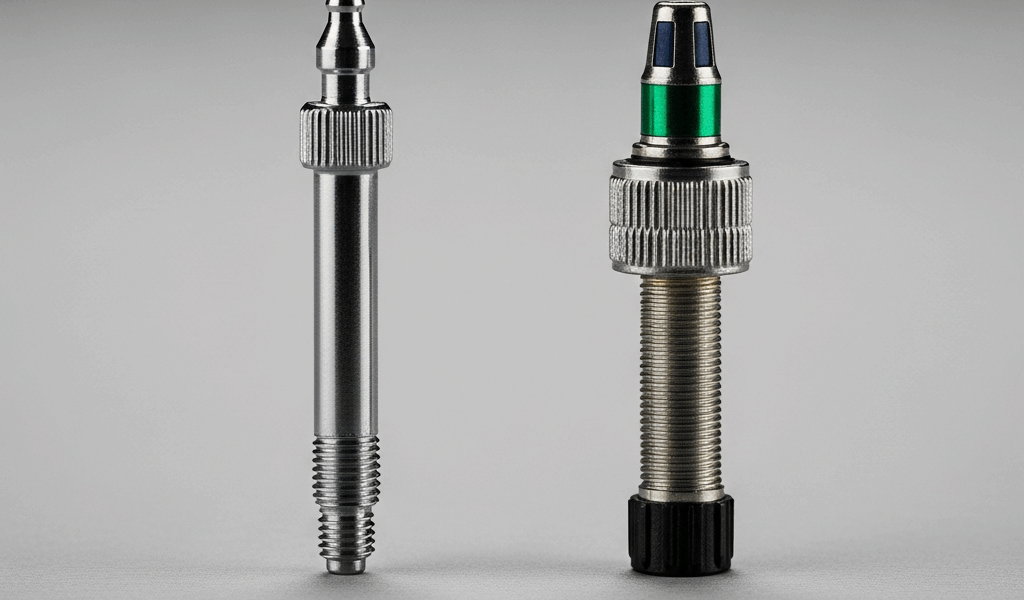
The main advantage of a Presta valve is its smaller rim hole, which suits narrow or lightweight bicycle rims and comes in many stem lengths. Schrader’s main advantage is convenience: it is robust, familiar, and works with automotive-style pump heads. Presta is not inherently “faster,” and Schrader is not inherently limited to low pressure. Your rim drilling usually determines which valve you should use.
For most riders, the correct choice is simple: keep the valve type the wheel manufacturer designed for, buy a pump head that fits it, and choose a stem long enough for the rim.
Presta vs Schrader at a glance
| Feature | Presta | Schrader |
|---|---|---|
| Stem diameter | Narrower | Wider, like an automotive tire valve |
| Rim hole | Smaller hole | Larger hole |
| Opening | Loosen the small tip nut, then press briefly before attaching the pump | Pump head depresses a spring-loaded center pin |
| Pump access | Presta head, dual head, or adapter required | Widely compatible with automotive-style heads |
| Stem lengths | Many options for deep-section rims | Fewer bicycle-specific long-stem choices |
| Removable core | Common, but not universal | Common and standardized |
| Typical bicycle use | Road, gravel, performance MTB, and most bicycle tubeless systems | City, hybrid, kids’, utility, and many mountain bikes |
Why road bikes often use Presta valves
A narrow rim leaves less material around a large drilled hole. Presta’s smaller stem lets the manufacturer use a smaller opening, which is useful on narrow rims and can simplify rim design. That is the durable advantage—not the claim that a tiny valve automatically makes the wheel stronger in every case.
Presta stems are also sold in lengths suited to deep aerodynamic rims. A standard short Schrader stem may be inaccessible inside a deep rim, while long Presta tubes and valve extenders are widely available.
The valve’s small screw tip allows controlled release of air by pressing it. This can make trail-side or race-pressure adjustments convenient, but accurate adjustment still requires a pressure gauge. The top nut closes the valve plunger; it is not a magic second seal that prevents normal air diffusion through a tube.
Are Presta valves better at high pressure?
Presta valves became associated with high-pressure road tires, but valve type alone does not establish a safe pressure. Schrader valves are used in applications with substantial pressure. On a bicycle, the tire, rim, rim tape, tube or tubeless system, valve, and manufacturer limits must all be compatible.
Modern road tires also do not all need 100-plus PSI. Appropriate pressure depends on tire width, measured tire size, total load, rim type, surface, and whether the system uses tubes or tubeless. Never inflate to a generic article’s recommendation when a lower tire or rim maximum applies.
Schrader’s real advantages
Schrader stems are mechanically robust and easy for occasional riders to recognize. Compatible pumps and gauges are widespread. The core sits recessed in the metal stem, reducing the chance of bending an exposed tip while attaching a pump.
That does not mean a gas-station compressor is automatically safe for a bicycle. High-flow equipment can overinflate a small tire very quickly, the gauge may be inaccurate at bicycle volumes, and the chuck can stress the stem. Use a regulated inflator with a reliable gauge and proceed in small bursts. A Presta-to-Schrader adapter changes the pump connection; it does not make uncontrolled compressed air safe.
Which valve holds air longer?
Neither valve type guarantees better air retention. A properly functioning Presta or Schrader core can seal well. Daily pressure loss is often dominated by air permeating through the tube or tire casing, sealant condition, temperature, a loose or contaminated core, damaged rim tape, or a puncture.
If a tire loses pressure overnight, use soapy water or immersion where appropriate to inspect the valve core, stem base, tube, bead, and rim tape. Our overnight pressure-loss diagnostic walks through those causes.
Pump compatibility
Many bicycle floor pumps have a dual head, reversible insert, or smart head that handles both valve types. Do not force the wrong opening over a stem. Check the pump markings and instructions.
How to inflate a Presta valve
- Remove the cap if present.
- Unscrew the small nut at the valve tip until it stops; do not remove it.
- Press the tip briefly to make sure it is free.
- Fit the correct pump head squarely and lock the lever if required.
- Inflate without bending the stem, using a reliable gauge.
- Release the pump head carefully and tighten the tip nut finger-tight.
How to inflate a Schrader valve
- Remove the cap.
- Fit the Schrader pump head squarely; the head depresses the center pin.
- Inflate to the selected safe pressure.
- Remove the head without levering the stem sideways and replace the cap.
See our bike-pump selection guide for head types, gauges, and portable options.
Can you put Presta in a Schrader-drilled rim?
Sometimes, but the narrow stem can move in the larger hole. A purpose-made reducer or grommet may support it and protect the tube at the rim opening. Confirm the solution with the rim or wheel manufacturer, especially for tubeless systems. An unsupported tube stem can chafe or tear at its base.
Can you put Schrader in a Presta-drilled rim?
Not without enlarging the hole, and drilling can remove critical material, leave a sharp edge, void a warranty, or damage a carbon or composite rim. Do not drill a rim unless its manufacturer explicitly approves the modification and method. The safer solution is normally to use the valve type the rim was designed around.
Tube and tubeless differences
On an inner tube, the valve is permanently bonded to the tube. A removable core can be serviced, but a tear at the stem base requires replacing or properly repairing the tube as applicable.
On a tubeless bicycle wheel, the valve is a separate component sealing against the rim tape and rim bed. Presta dominates current performance bicycle tubeless systems because narrow holes, long stems, and removable cores make installation and sealant service convenient. Schrader tubeless valves also exist and may be appropriate when the rim is designed for them.
Do not assume every Presta core is removable. Look for wrench flats on the core and follow the tube or valve manufacturer’s instructions. Overtightening a removable core or tubeless retaining nut can damage seals or make roadside service difficult.
What are the two Presta nuts?
The tiny nut at the tip opens and closes the valve plunger. It must be loosened for inflation and gently tightened afterward.
The separate nut sometimes supplied at the rim holds the stem during installation. Many riders omit it on tube setups; tubeless valve nuts are part of the sealing and retention system. In either case, follow the manufacturer’s instructions and do not use pliers to crush the rim or gasket.
Stem length and valve extenders
The exposed stem must be long enough for the pump head to engage fully. Measure rim depth and leave adequate usable stem beyond the rim. Deep-section wheels may require a longer tube valve or a compatible extender.
Extenders differ: some require a removable core, while others fit over an opened valve. A buried loose tip or leaking threaded joint is difficult to fix after the tire is installed, so test inflation and leak-tightness before the final assembly.
Common Presta problems
- Pump will not add air: the tip nut may still be closed, the pin may be stuck, or the pump insert may be reversed.
- Tip bends: the pump head was attached or removed at an angle; support the head and pull straight.
- Core unscrews with the pump: thread-on pump hoses can loosen removable cores; tighten the core to its specified torque with the proper tool.
- Leak at stem base: inspect tube damage or, for tubeless, the valve gasket and rim tape.
- Stem too short: use the correct longer valve or compatible extender instead of barely attaching the pump.
Which valve should you choose?
- Existing wheel: use the valve type and hole size specified by the wheel maker.
- Narrow or deep road rim: Presta is usually the practical standard.
- Utility or kids’ bike: Schrader may be more convenient when the rim is designed for it.
- Tubeless conversion: use a valve explicitly compatible with the rim bed, hole, depth, tape, and tire system.
- Touring: pump and spare availability matter, but a small Presta-to-Schrader adapter can broaden inflation options.
Bottom line
The advantage of Presta is packaging: a narrower hole, many stem lengths, and broad support in performance and tubeless bicycle systems. The advantage of Schrader is accessible, robust compatibility. Neither is universally superior, neither determines safe tire pressure by itself, and neither justifies drilling an unapproved rim.
Technical reference: Schwalbe’s bicycle-valve guidance. Always defer to the current tire, tube, rim, wheel, valve, and pump instructions for your exact components.

Stay in the loop
Get the latest cycling gear galaxy updates delivered to your inbox.