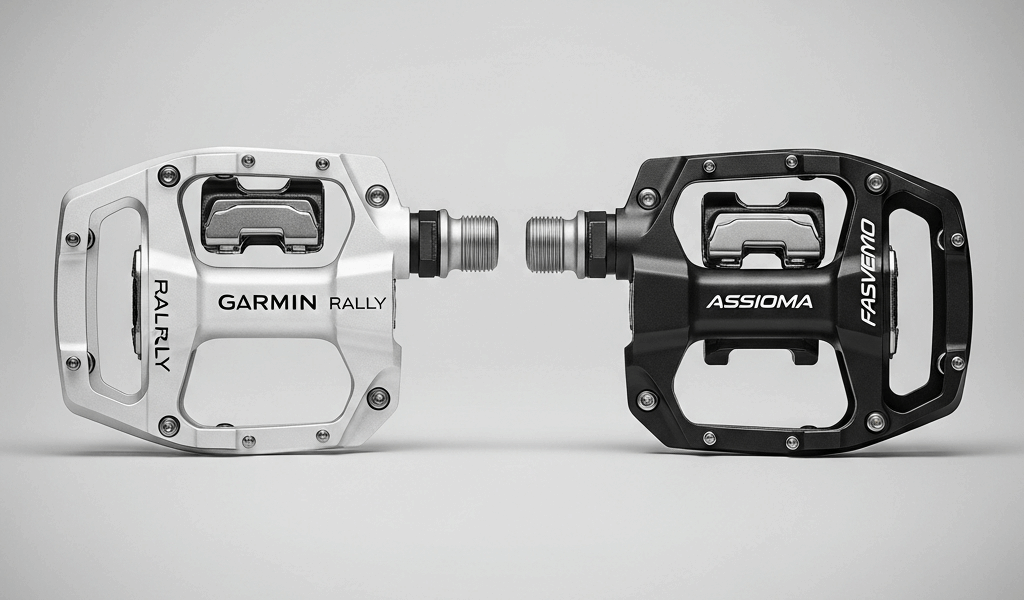
Garmin Rally vs Favero Assioma Power Meter Pedals — Which Are Worth It?
The Garmin Rally vs Favero Assioma decision stopped me cold for about three weeks last spring. I had finally committed to training with power — real power data, not the guess-work heart rate stuff I’d been relying on — and I was staring at two very different price tags on two pedals that, on paper, seemed to do the same thing. Spoiler: they don’t do exactly the same thing, and the difference matters depending on who you are as a rider.
I ride a Specialized Tarmac SL6 with Shimano cleats, log somewhere between 150 and 200 miles a week, and I use TrainerRoad for structured training blocks through winter. That context matters because these pedals serve different riders differently. What I found after testing both — and yes, I ran the Assioma Duo on my training bike while a friend ran the Rally RS200 on his — might save you a few hundred dollars or confirm that the premium is worth every cent.
Price Gap — Is Double the Cost Justified?
Let’s get the uncomfortable part out of the way immediately. The Favero Assioma Duo currently retails for around $599 USD. The Garmin Rally RS200 — the dual-sided Shimano-compatible version — runs $1,199.99 USD at most retailers including REI, Clever Training, and directly through Garmin’s own site. That is, at the time of writing, a $600 difference. Six hundred dollars. That’s another wheelset upgrade, a high-end helmet, or twelve months of TrainerRoad.
So what does that extra $600 buy you? A few things, genuinely. The Rally RS200 measures power from both left and right pods independently and gives you left/right balance, just like the Assioma Duo. Both are dual-sided. Both give you cadence, total power, and power balance. The Rally adds running dynamics if you ever clip in for a triathlon — a feature that matters to exactly zero percent of pure road cyclists. It also integrates more tightly into the Garmin Connect ecosystem, which we’ll talk about below.
Frustrated by the vague marketing language on both websites, I made a literal spreadsheet comparing every listed feature. The Rally’s advantages came down to: Garmin ecosystem depth, the running dynamics add-on, and a slightly more premium build finish. The Assioma’s advantages were: rechargeable batteries, lighter individual pod weight at 71 grams per pedal versus the Rally’s 95 grams, and that $600 still sitting in your pocket.
- Favero Assioma Duo — ~$599 USD, 71g per pedal, rechargeable via USB-C
- Garmin Rally RS200 — $1,199.99 USD, 95g per pedal, replaceable CR2032 batteries
- Both offer dual-sided power measurement and +/- 1% claimed accuracy
- Rally supports SPD-SL, Look, and SPD cleats depending on variant; Assioma uses proprietary Favero cleats based on Look Kéo
The price gap is real and significant. Whether it’s justified comes down entirely to which ecosystem you live in and how much the extra features mean to your actual riding life.
Accuracy and Consistency in Real Riding
Both Garmin and Favero claim accuracy of +/- 1%. On paper, identical. In real riding, the picture is a little more nuanced — and this is where I learned my biggest lesson about trusting spec sheets.
Early on, I assumed that matching claimed specs meant matching real-world performance. I was wrong. The more useful data comes from long-term user reports, velodrome testing comparisons, and the kind of anecdotal evidence that accumulates across forums like the TrainerRoad subreddit and the Slowtwitch forums over years of real use.
What that evidence consistently shows: the Assioma Duo performs extremely well in controlled comparisons against lab-grade devices. DCRainmaker’s exhaustive testing — probably the most rigorous independent review resource available for cycling tech — has repeatedly shown the Assioma tracking within a fraction of a percent against Quarq and SRM reference meters. The Rally RS200 also performs well, but several long-term users report slightly more temperature sensitivity in very cold conditions, with drift becoming noticeable below 5°C (41°F) on extended winter rides.
Calibration matters here. Both pedals benefit from a zero-offset calibration before rides, especially after temperature changes. The Assioma does this automatically if you leave it connected to the app — it performs a static calibration without input. The Rally requires manual zero-offset via your Garmin head unit, which takes about four seconds but is one more thing to forget.
Left/Right Balance Data
Both systems capture true left/right balance because both measure at each pedal independently. This isn’t an extrapolated or estimated balance figure — it’s actual strain gauge data from both sides. For riders working through a known imbalance or coming back from injury, this is the feature that justifies dual-sided over single-sided in the first place. My own data showed a persistent 52/48 left-heavy split that I’d had no idea about until I started using power pedals. Discovering that was worth the cost of entry alone.
Bottom line on accuracy: both are excellent. Neither will let you down in a meaningful way for training or racing purposes. If sub-0.5% precision in freezing temperatures is critical to you, the Assioma edges ahead based on real-world reports.
Battery Life and Maintenance
Probably should have opened with this section, honestly. Battery logistics are the kind of unglamorous detail that ends up affecting your day-to-day experience with these pedals far more than any spec comparison.
The Favero Assioma Duo uses integrated rechargeable lithium batteries. Claimed battery life is 50 hours per charge. In practice, I consistently got between 45 and 52 hours depending on whether I was using the Bluetooth connection to the app during rides. Charging is via a proprietary magnetic cable — not USB-C as I initially thought when I bought them, which was a mild annoyance — and takes about 2.5 hours from flat. You charge them on the bike, which is convenient. The cables snap magnetically to contacts on the back of each pod.
The Garmin Rally RS200 runs on CR2032 coin cell batteries. Claimed life is 120 hours per set. Replacement batteries cost roughly $2–4 each and are available everywhere from pharmacies to gas stations. No charging cable to keep track of. No planning around charge cycles before a big event.
This is a genuine split decision and depends on your riding personality. If you’re the type who rides every day and would rather charge once a week than ever think about carrying spare batteries, the Assioma wins. If you do occasional long rides and travel frequently — especially internationally — the idea of swapping in a $2 battery at a hotel in Portugal at 11pm instead of hunting for a charging socket is meaningfully appealing. I’ve been in exactly that situation, and the Rally’s approach would have saved me a minor panic.
- Assioma Duo — 50-hour rechargeable, magnetic proprietary cable, charges on-pedal
- Rally RS200 — 120-hour replaceable CR2032, universally available batteries
- Long-term cost of CR2032s over 3 years of regular riding is minimal — under $20 total
- Assioma battery replacement (when cells eventually degrade) requires sending pedals to Favero — a consideration for 5+ year ownership
App Ecosystem and Data
This is where the two companies live in genuinely different worlds, and where the Rally’s premium price finds some of its strongest justification — if you’re already in the Garmin universe.
The Garmin Rally connects to Garmin Connect, which is a mature, feature-rich platform with deep integration across Garmin’s entire product line. If you ride with a Garmin Edge 530, 830, or 1040, the Rally talks to your head unit with zero setup friction. Power data, cadence, left/right balance, and advanced metrics like platform center offset and pedal smoothness all flow directly. The Garmin Connect app on your phone surfaces all of it with clean visualization and long-term trend analysis.
The Favero Assioma uses the Favero Assioma app for firmware updates and configuration. It’s functional but sparse. The app isn’t where you live with this data — it’s mostly a utility for updates and calibration checks. The real-world data experience happens in whatever head unit or app you’re already using.
Here’s the thing: the Assioma broadcasts over both ANT+ and Bluetooth simultaneously. That means it plays perfectly with every major platform — Zwift, TrainerRoad, Wahoo ELEMNT, Garmin head units, Polar, Suunto, and anything else you’d reasonably want to use. Tested this personally with TrainerRoad on an iPad and a Wahoo ELEMNT Bolt simultaneously capturing the same ride. Zero dropouts, no pairing conflicts.
Zwift and TrainerRoad Compatibility
Both pedals work flawlessly with Zwift and TrainerRoad via Bluetooth or ANT+. No caveats there. The Rally’s advantage is purely in the deeper Garmin Connect integration for riders who already use Garmin devices and want everything consolidated in one ecosystem with no manual data exports. If you use a Wahoo head unit or ride primarily on a non-Garmin device, that advantage disappears entirely.
Strava gets the data either way through automatic sync — Garmin Connect to Strava, or directly from Wahoo, TrainerRoad, or Zwift. Power data appears in Strava identically regardless of which pedal sourced it.
The Verdict — Who Should Buy Which
After running both systems across a full training block — not just a two-week test but an actual 12-week base period through a miserable February and March — here’s where I landed.
Driven by a genuine attempt to make this recommendation without bias, I kept asking the same question: what does the $600 premium on the Rally actually change about my training? And the honest answer, for most riders, is not much.
Buy the Favero Assioma Duo if:
- You use a Wahoo, Polar, or non-Garmin head unit
- You train primarily on Zwift or TrainerRoad and don’t need deep Garmin Connect integration
- You want the best accuracy-per-dollar ratio available in pedal-based power meters right now
- You prefer rechargeable batteries and a clean, no-battery-buying setup
- You ride Look Kéo cleats or are willing to switch — the Assioma uses a Kéo-compatible system
Buy the Garmin Rally RS200 if:
- You’re deeply embedded in the Garmin Connect ecosystem across multiple Garmin devices
- You do triathlons and actually want running dynamics from the same pedals
- You travel frequently and prioritize universally available replaceable batteries over rechargeable convenience
- You ride SPD-SL (Shimano) cleats and don’t want to change your cleat system
- Budget is genuinely not a constraint and you want the Garmin brand’s warranty and support infrastructure
The clear overall winner for the majority of cyclists is the Assioma Duo. Not because the Rally is bad — it isn’t — but because for $599 you get accuracy that matches or exceeds the Rally in most conditions, a lighter pedal, a cleaner charging experience, and universal ecosystem compatibility. The $600 you save buys a lot of other improvements to your training setup.
If you’re a Garmin loyalist with a 1040 on your bars and an Instinct on your wrist and you’ve never thought about using anything other than Garmin Connect for your data, the Rally’s premium is at least understandable. The integration is genuinely seamless and the build quality is excellent. You’re paying for belonging to a complete ecosystem.
Everyone else: put the Assioma Duo in your cart, bank the difference, and spend it on a proper bike fit or a coaching plan. That investment will do more for your power numbers than any pedal brand loyalty.



Stay in the loop
Get the latest cycling gear galaxy updates delivered to your inbox.