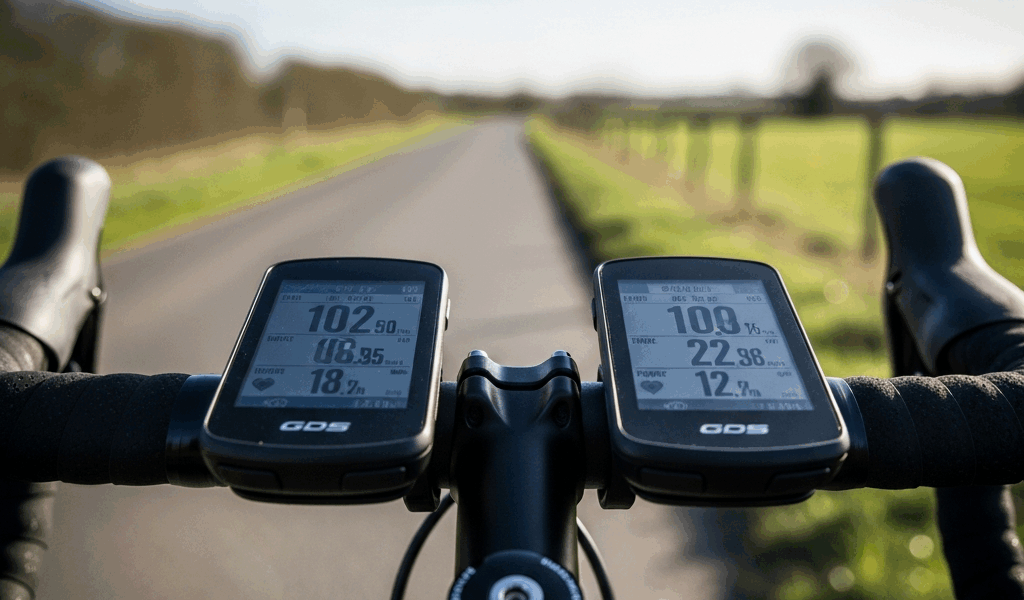
You need a cycling computer and it’s come down to two: the Garmin Edge or the Wahoo ELEMNT Roam. Both sit in the $350-450 range. Both record rides, display power, sync to Strava, and mount on your handlebars. At a spec-sheet level, they look almost identical — which is exactly why the decision feels impossible.
This article includes affiliate links. We may earn a commission at no extra cost to you.
They’re not identical. They solve different problems for different types of riders. Here’s where each one actually wins.
Screen, Interface, and Daily Use
Garmin uses a touchscreen with deep, layered menus. The initial setup takes time — you’ll spend 20-30 minutes configuring data fields, screens, and alerts before your first ride. But once configured, the customization is powerful. You can build screens with exactly the metrics you want, arranged however you like.
Wahoo uses physical buttons with smartphone app setup. Configuration happens on your phone, not on the device. The ELEMNT Roam’s ride start experience is genuinely faster — power on, wait for GPS, go. No menus to navigate, no screens to swipe through. Two taps and you’re recording.
For everyday ride start, Wahoo wins on simplicity. For mid-ride adjustments in cold weather with thick gloves, the physical buttons are easier to hit than a touchscreen — though Garmin’s newer models handle wet-touch gloves better than older versions.
The tradeoff: Garmin’s touchscreen lets you do more on the device itself. Wahoo’s simplicity means you need your phone nearby for anything beyond basic settings.
Navigation and Route Following
This is where the biggest gap exists between the two platforms.
Garmin Edge wins navigation by a wide margin. Full turn-by-turn directions, course alerts, ClimbPro for upcoming elevation profiles, and comprehensive map data that shows roads, trails, and points of interest. If you ride new routes regularly in unfamiliar areas, Garmin’s navigation is a genuine advantage that Wahoo hasn’t matched.
Wahoo Roam handles route following — you load a route from Strava or RideWithGPS and it shows a breadcrumb trail on the map. It works. But the guidance is less refined than Garmin’s, without the same level of map context or proactive turn alerts. If you miss a turn, Wahoo tells you — but Garmin prevents you from missing it in the first place.
For cyclists who always ride known routes — the same local loops, the same training roads — navigation is completely irrelevant to this decision. If that describes your riding, skip this category entirely when deciding.
Smart Trainer and Indoor Cycling Integration
If you own a Wahoo KICKR trainer and use Zwift or Rouvy, the Wahoo ELEMNT Roam has an ecosystem advantage. ELEMNT pairs with KICKR trainers automatically — no manual pairing, no connection drops, no setup steps. Workout data syncs between indoor and outdoor rides seamlessly.
Garmin Edge works with Wahoo trainers via ANT+ and Bluetooth, but the initial setup requires a few more steps. The connection is reliable once established, but it doesn’t have the same instant-recognition that staying within the Wahoo ecosystem provides.
For cyclists who split training between outdoor road rides and indoor Zwift sessions on a Wahoo trainer, the ecosystem cohesion genuinely simplifies the daily routine. If you run a non-Wahoo trainer (Tacx, Saris, Elite), this advantage disappears — both platforms connect equally well over standard protocols.
Third-Party App Ecosystem: Strava, TrainingPeaks, and More
Both sync to Strava, TrainingPeaks, and Today’s Plan without issues. TrainingPeaks workout execution (following structured intervals on the device) is comparable on both. The basics are covered equally.
Garmin goes deeper with its Connect platform. Training Effect scores, Body Battery (if paired with a compatible heart rate monitor), HRV Status, and the Connect IQ app store for third-party data fields and widgets. If you want detailed post-ride analytics beyond what Strava provides, Garmin Connect is the more powerful tool.
Wahoo’s app-based dashboard is leaner. It covers what 90% of road cyclists actually look at — ride distance, average power, heart rate zones, elevation. For riders following a coach’s plan on TrainingPeaks, Wahoo provides everything needed. The extra analytics Garmin offers are only valuable if you actually use them.
Honest assessment: most recreational and even competitive amateur cyclists don’t use Training Effect scores or Body Battery. If that data interests you, Garmin wins. If your post-ride routine is “upload to Strava, check the map, close the app,” both platforms handle that identically.
Verdict: Which Computer for Which Cyclist
Choose the Wahoo ELEMNT Roam (~$380) if: You want something that works immediately with minimal setup. You own a Wahoo smart trainer and ride indoors regularly. You ride mostly familiar routes where navigation isn’t needed. You value simplicity over customization.
Choose the Garmin Edge 540 (~$350) or 840 (~$450) if: Navigation matters to your riding — new routes, travel, exploring. You follow structured training plans on TrainingPeaks and want granular analytics. You like customizing data screens and digging into post-ride numbers. You want ClimbPro for elevation profiling on rides with real climbing.
The price points are nearly identical — Wahoo Roam at $380 and Garmin Edge 540 at $350 — so this isn’t a budget decision. It’s a capability-fit decision. The wrong answer isn’t picking one over the other. The wrong answer is buying based on brand loyalty instead of matching the tool to how you actually ride.




Stay in the loop
Get the latest cycling gear galaxy updates delivered to your inbox.