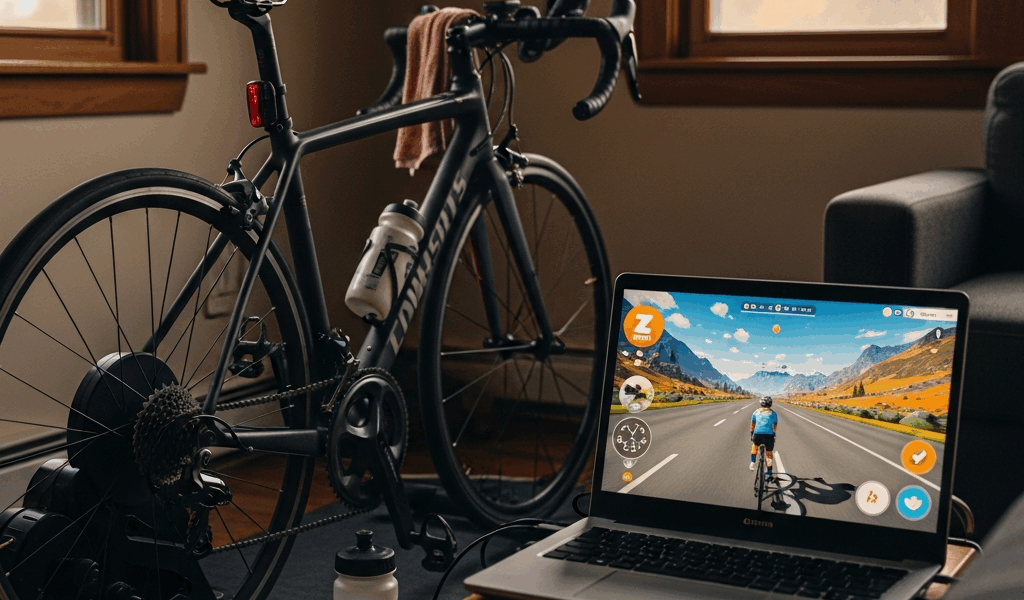
You keep seeing Zwift ads showing riders hammering up virtual mountains, racing people across the world, and somehow looking genuinely excited about indoor cycling. The subscription is $19.99 a month. That seems reasonable. But when you start researching what you actually need to run Zwift, the real number gets bigger fast — and nobody tells you that upfront.
Here’s the honest cost breakdown, including the equipment most beginners actually buy (used, not flagship), so you can decide whether Zwift makes sense for your budget and riding goals.
This article includes affiliate links. We may earn a commission at no extra cost to you.
The $19.99/Month Subscription Is Just the Beginning
Zwift costs $19.99 per month or $169.99 per year ($14.17/month). But the app by itself does nothing. You need a trainer that connects to Zwift and adjusts resistance based on the virtual terrain. Without compatible hardware, Zwift is just a screensaver with power numbers.
The honest question isn’t “is $20 per month worth it” — it’s “is $300-500 in equipment plus $170 per year worth it.” That reframes the decision entirely, and it’s the number you need to budget for before committing.
Budget Entry: Wheel-On Trainers ($100-300 for the Trainer)
A basic wheel-on trainer (Wahoo KICKR SNAP, Saris M2, or an older magnetic trainer) presses your rear tire against a roller. These trainers work with Zwift, but with significant caveats.
Most wheel-on trainers aren’t “smart” trainers — Zwift can’t automatically control the resistance. You shift gears manually to change effort, and the power numbers come from a virtual power curve that estimates wattage based on wheel speed. The accuracy is rough — sometimes 10-20% off from actual power output.
Total cost at this tier: $100-300 for the trainer (used mag trainers go for $50-100 on Facebook Marketplace), plus a $40-60 speed and cadence sensor if the trainer doesn’t broadcast its own data. Call it $150-350 total.
This setup works for getting a feel for Zwift. But the experience is fundamentally different from what the platform is designed for. When ads show riders sprinting up a virtual hill with resistance automatically increasing — that requires a smart trainer, not a wheel-on with sensors. Be honest with yourself about whether the budget version will hold your attention past the first month.
Real Zwift Setup: Direct Drive Smart Trainer ($400-800 New)
Direct drive smart trainers — Wahoo KICKR CORE, Tacx Flux S, Saris H3 — are what Zwift is built for. You remove your rear wheel, bolt your bike directly to the trainer, and resistance changes automatically as you climb, sprint, or ride into virtual headwinds. This is the experience people are talking about when they say Zwift changed their winter training.
New prices: $450-800 depending on brand and model. But the used market is strong. A used Wahoo KICKR CORE in good condition runs $300-450. A used Tacx Flux goes for $250-350. I picked up a used CORE on Facebook Marketplace for $325 and it works exactly like a new one — these are metal and electronics, not consumables.
At this price point, Zwift is genuinely worth it. The automatic resistance makes the platform feel like an actual ride. Climbing feels like climbing. Sprints respond instantly. ERG mode holds your power steady during structured workouts. This is the minimum honest recommendation for a beginner asking whether Zwift makes sense.
What Zwift Actually Delivers for Beginners
Structured workouts with automatic resistance: The trainer adjusts to hit your target power. You just pedal. FTP builder plans, recovery rides, and sprint workouts are all included in the subscription — no additional purchase needed.
Group rides at any hour: Pace Partners run 24/7 at various speeds. Organized group rides fire off every 15-30 minutes across all time zones. At 5 AM on a Tuesday, you can still ride with 30 other people. This is something no local group ride can match.
Racing: Zwift races happen at multiple fitness categories. You’ll find events for beginners, intermediate riders, and competitive cyclists. The racing experience — positioning, drafting, attacks — is surprisingly engaging once you try it.
Motivation that sticks: The biggest benefit for most beginners isn’t a specific feature — it’s consistency. Many cyclists who could never maintain winter fitness on a solo trainer find that Zwift’s social and gamification elements keep them riding 3-4 times per week all winter. That consistency matters more than any single workout.
What Zwift is not: It’s not a replacement for outdoor riding when it comes to bike handling, cornering, or group ride skills. It’s a training and fitness tool — best used as a winter supplement or bad-weather backup, not your only source of saddle time year-round.
The Honest Verdict: Worth It If You Have the Right Equipment
Zwift is worth the money if you pair it with a smart trainer — used or new. The subscription at $170 per year is cheaper than most gym memberships and delivers a better indoor cycling experience than any gym spin bike.
It is not worth it on a $100 magnetic trainer with speed sensors. The experience is frustrating and doesn’t represent what the platform can do. If that’s your budget right now, save up for a used direct drive trainer before subscribing.
Realistic first-year budget: $250-350 for a used direct drive trainer + $169.99 for an annual subscription = roughly $420-520 total. Second year onward: $170. That’s $14 per month for unlimited indoor cycling with global group rides, structured training, and racing. For a beginner who needs winter motivation, it’s one of the best values in cycling.
Start with the used market for your trainer. Subscribe annually instead of monthly. And give it at least 6 weeks before judging — the first few rides feel awkward for everyone. The platform clicks once you find a group ride or a training plan that matches your fitness level.
Before paying for Zwift, compare the experience and household pricing with its closest alternative. See our current ROUVY vs Zwift guide for official 2026 prices and hardware notes.



Stay in the loop
Get the latest cycling gear galaxy updates delivered to your inbox.